
Introduction: Understanding Molecular Signatures Through Spectral Analysis
The identification and characterization of chemical compounds require analytical approaches capable of revealing their structural properties, molecular composition, and physicochemical behavior. Among the most valuable tools in modern analytical science, spectroscopy provides a detailed perspective on molecular systems by examining their interactions with electromagnetic radiation.
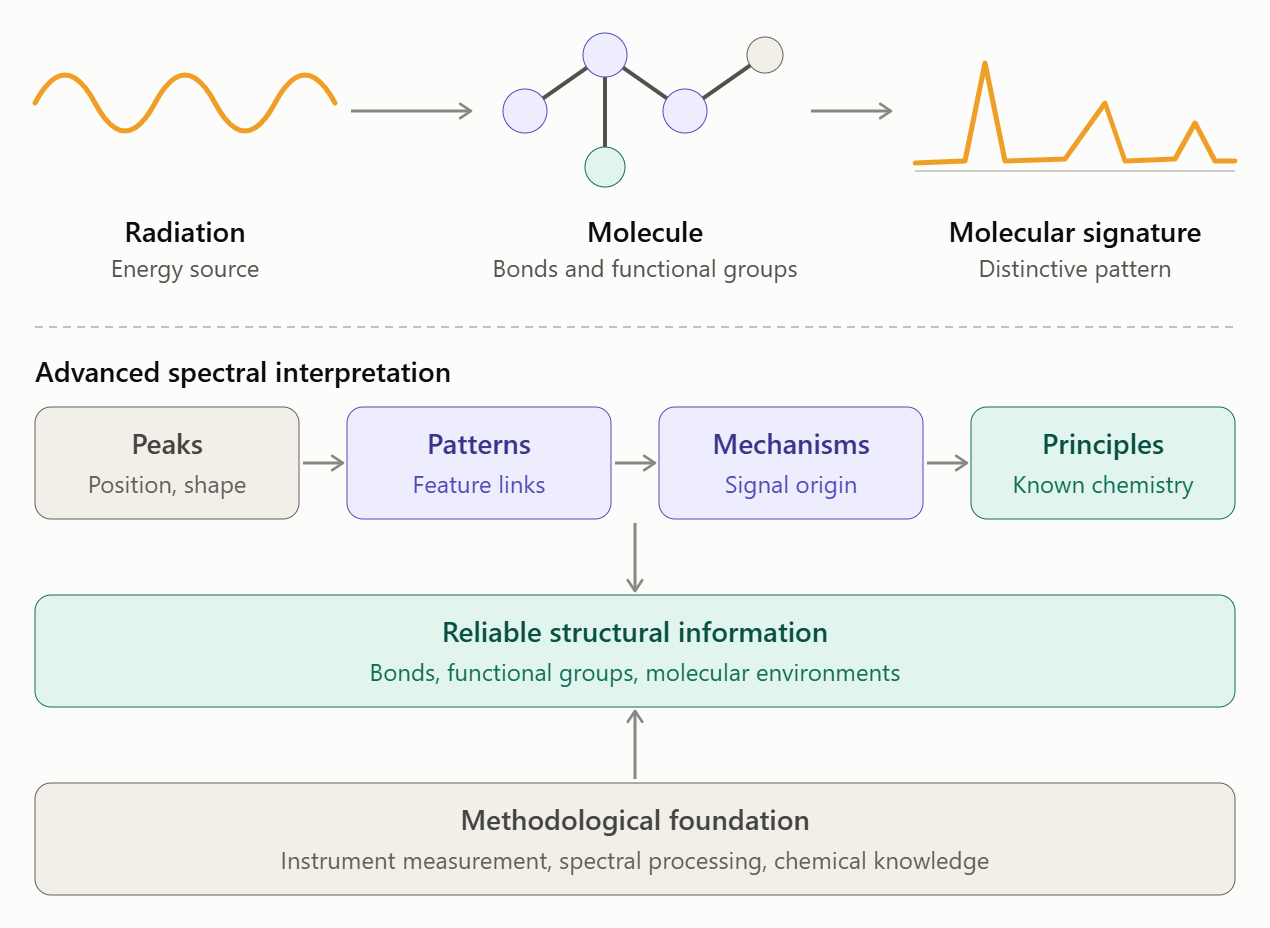
Every molecular structure possesses specific characteristics that influence its interaction with energy. These interactions generate measurable signals that can be interpreted to obtain information about chemical bonds, functional groups, molecular environments, and structural organization.
A molecular signature represents a distinctive pattern of analytical responses associated with a particular substance or molecular system. Investigating these signatures requires a combination of instrumental measurements, spectral processing, chemical knowledge, and scientific interpretation.
Advanced spectral interpretation therefore extends beyond the identification of individual peaks. It involves examining relationships between spectral features, understanding the physical mechanisms responsible for signal generation, and comparing experimental observations with established chemical principles.
This article explores the scientific foundations of molecular signatures, the analytical techniques used to investigate them, and the methodological considerations involved in obtaining reliable structural information.
The Scientific Foundations of Molecular Spectral Signatures
Molecules interact with electromagnetic radiation through different physical mechanisms depending on their chemical structure and energy levels.
When radiation interacts with matter, energy may be absorbed, emitted, or scattered. These processes produce characteristic analytical signals that can provide information about molecular composition and organization.
The resulting spectral patterns depend on several factors:
Molecular structure and chemical bonding.
Distribution of electrons within molecular orbitals.
Vibrational and rotational energy levels.
Molecular symmetry and structural configuration.
Chemical environment and surrounding solvent.
Temperature and experimental conditions.
Interactions between neighboring molecules.
The interpretation of these properties allows researchers to associate specific spectral features with molecular characteristics.
For example, the presence of particular absorption bands in infrared spectroscopy can indicate characteristic chemical bonds, while ultraviolet-visible absorption may provide information about electronic transitions within conjugated molecular systems.
Understanding the physical principles behind these signals is essential for distinguishing meaningful molecular information from experimental variations.
Molecular Vibrations and Infrared Spectral Interpretation
Infrared spectroscopy is one of the most widely applied techniques for investigating molecular structures.
It is based on the absorption of infrared radiation by molecules undergoing vibrational transitions. These vibrations involve changes in bond lengths and bond angles and depend on the masses of the participating atoms and the strength of their chemical bonds.
Two principal categories of molecular vibrations are generally distinguished.
Stretching vibrations
These involve changes in the distance between two bonded atoms. Stretching may occur symmetrically or asymmetrically depending on the movement of the participating atoms.
Bending vibrations
These involve changes in bond angles and include different movements such as scissoring, rocking, wagging, and twisting.
The resulting absorption bands provide valuable information about the chemical groups present in a sample.
Characteristic Infrared Absorption Regions
Functional group | Approximate absorption region |
|---|---|
O–H stretching | 3200–3600 cm⁻¹ |
N–H stretching | 3300–3500 cm⁻¹ |
C–H stretching | 2800–3100 cm⁻¹ |
C≡N stretching | 2100–2260 cm⁻¹ |
C=O stretching | 1650–1800 cm⁻¹ |
C=C stretching | 1600–1680 cm⁻¹ |
C–O stretching | 1000–1300 cm⁻¹ |
These ranges are approximate and may vary according to molecular environment, hydrogen bonding, conjugation, and other structural effects.
The fingerprint region, generally located below approximately 1500 cm⁻¹, is particularly valuable because it contains complex vibrational patterns that can help distinguish chemically related substances.
Understanding Spectral Band Variations
The position, intensity, width, and shape of absorption bands provide complementary information.
A shift in absorption frequency may indicate changes in the chemical environment or molecular interactions. Variations in band intensity can reflect differences in concentration, transition probability, or experimental conditions.
Broad absorption bands may also result from hydrogen bonding and overlapping vibrational transitions.
Consequently, infrared interpretation requires the examination of the complete spectral profile rather than relying on a single absorption peak.
Electronic Transitions and Ultraviolet-Visible Spectroscopy
Ultraviolet-visible spectroscopy investigates the absorption of ultraviolet and visible radiation associated with electronic transitions.
When a molecule absorbs energy, electrons may move from lower-energy molecular orbitals to higher-energy orbitals.
Several electronic transitions are particularly relevant to organic molecular systems:
Sigma to sigma-star transitions.
Nonbonding to sigma-star transitions.
Pi to pi-star transitions.
Nonbonding to pi-star transitions.
The nature of these transitions depends on the molecular structure, electron distribution, and electronic configuration.
Conjugated systems often exhibit characteristic absorption behavior because electron delocalization influences the energy difference between molecular orbitals.
Chromophores and Molecular Absorption
A chromophore is a structural component responsible for the absorption of electromagnetic radiation within a particular spectral region.
Examples include conjugated double-bond systems, aromatic structures, and carbonyl-containing groups.
The absorption characteristics of chromophores can be influenced by:
The extent of electronic conjugation.
Molecular substitution.
Solvent polarity.
Protonation and ionization states.
Molecular aggregation.
Interactions with surrounding chemical groups.
These factors may produce changes in absorption maxima and spectral intensity.
Raman Spectroscopy and Molecular Fingerprinting
Raman spectroscopy provides complementary information to infrared spectroscopy through the analysis of inelastic light scattering.
When monochromatic light interacts with a molecular system, most photons undergo elastic scattering. A small proportion undergoes inelastic scattering, resulting in changes in photon energy associated with molecular vibrational transitions.
These energy differences generate Raman shifts that provide information about molecular structure.
Unlike infrared absorption, Raman activity depends on changes in molecular polarizability during vibration.
This distinction makes Raman spectroscopy particularly useful for investigating molecular systems that may produce weak or different infrared responses.
Important Applications of Raman Analysis
Raman spectroscopy can be used to investigate:
Molecular vibrations and chemical bonding.
Carbon-based materials.
Crystalline and amorphous structures.
Pharmaceutical compounds.
Polymer composition.
Molecular organization in complex materials.
Chemical variations within heterogeneous samples.
The combination of Raman and infrared spectroscopy can provide a more comprehensive understanding of molecular structures because the two techniques follow different spectroscopic selection rules.
Fluorescence Spectroscopy and Molecular Excitation
Fluorescence spectroscopy examines the emission of light by molecules following the absorption of electromagnetic radiation.
After excitation, molecules may undergo different relaxation processes before returning to their ground electronic state.
Fluorescence emission generally occurs at a longer wavelength than the excitation radiation because part of the absorbed energy is dissipated through non-radiative processes.
This phenomenon is associated with the Stokes shift.
Factors Influencing Fluorescence Signals
Fluorescence intensity and spectral characteristics depend on several parameters:
Molecular structure and electronic configuration.
Excitation wavelength.
Emission wavelength.
Solvent polarity.
Temperature and pH.
Molecular concentration.
Quenching interactions.
Photochemical stability.
Fluorescence quenching is particularly important because interactions with other molecules or environmental factors may reduce emission intensity.
Fluorescence measurements are widely used in biochemical investigations, molecular interaction studies, analytical detection, and the characterization of fluorescent compounds.
Mass Spectrometry and Molecular Composition
Although mass spectrometry is not a spectroscopic technique in the strict sense, it is an essential complementary analytical method for molecular identification and characterization.
It involves the formation of ions, their separation according to mass-to-charge ratio, and their subsequent detection.
The resulting mass spectrum contains information about molecular ions, isotopic distributions, and fragmentation patterns.
Molecular Ion Identification
The molecular ion or related ion species can provide information about the molecular mass of an investigated compound.
High-resolution mass spectrometry can provide accurate mass measurements that support the determination of possible molecular formulas.
Fragmentation Patterns
Fragmentation occurs when ions undergo dissociation into smaller ionic species.
These fragments can reveal structural information about the original molecule.
Interpretation requires consideration of:
Ionization mechanisms.
Molecular stability.
Bond dissociation pathways.
Characteristic fragment ions.
Isotopic patterns.
Collision energy and instrumental conditions.
Combining mass spectrometry with chromatographic separation and spectroscopic characterization can significantly improve the investigation of complex chemical mixtures.
Molecular Environments and Spectral Shifts
Spectral signatures are not determined exclusively by molecular structure. The surrounding chemical environment can also influence the position and intensity of analytical signals.
Interactions between molecules may modify their vibrational, electronic, or rotational energy levels.
These changes are particularly important when investigating compounds in solution, molecular complexes, biological systems, and organized material structures.
Hydrogen Bonding
Hydrogen bonding can influence vibrational frequencies, particularly those associated with hydroxyl and amino groups.
In infrared spectra, hydrogen bonding may produce broader absorption bands and shifts toward lower wavenumbers.
Solvent Effects
Solvent polarity can influence electronic transitions and absorption maxima.
Depending on the nature of the transition, changes in solvent environment may produce bathochromic or hypsochromic shifts.
Molecular Aggregation
Molecular aggregation may modify spectral properties through intermolecular interactions and changes in electronic organization.
Such effects can be particularly relevant in investigations involving dyes, conjugated molecules, and supramolecular systems.
Understanding these environmental influences is essential when comparing spectra obtained under different experimental conditions.
Spectral Data Processing and Signal Optimization
Raw analytical measurements frequently contain instrumental noise, background contributions, and variations that may complicate interpretation.
Spectral preprocessing is therefore an important step in analytical workflows.
The objective is to improve data quality while preserving the chemically relevant information contained in the original measurements.
Common preprocessing approaches include:
Baseline correction
Used to compensate for background variations that may influence spectral intensity.
Smoothing
Applied to reduce high-frequency noise while preserving important spectral features.
Normalization
Used to facilitate comparisons between spectra with different overall intensities.
Background subtraction
Helps reduce contributions originating from solvents, substrates, or instrumental backgrounds.
Peak detection
Supports the identification of spectral maxima and the extraction of relevant analytical features.
Derivative spectroscopy
Can help resolve overlapping bands and reveal subtle changes in spectral profiles.
Preprocessing parameters must be selected carefully because excessive smoothing or inappropriate baseline correction can distort genuine analytical information.
Chemometrics and Multivariate Spectral Interpretation
Complex spectral datasets often contain numerous overlapping variables that cannot be interpreted adequately through individual peak analysis.
Chemometrics combines mathematical, statistical, and computational methods to extract meaningful information from analytical measurements.
These approaches can reveal patterns, identify similarities, and investigate relationships between spectral features and sample characteristics.

Principal Component Analysis
Principal component analysis reduces the dimensionality of complex datasets while preserving as much of the original variation as possible.
It transforms correlated variables into a smaller number of principal components.
This method can help researchers:
Identify similarities between samples.
Investigate spectral variation.
Detect unusual observations.
Explore relationships between analytical variables.
Visualize complex datasets.
Partial Least Squares Regression
Partial least squares regression is used to investigate relationships between spectral data and quantitative reference measurements.
It can support the development of predictive analytical models when sufficient representative calibration data are available.
Cluster Analysis
Cluster analysis groups observations according to their similarities.
In spectral investigations, it can be used to examine relationships between samples and identify groups exhibiting comparable analytical characteristics.
These computational methods are particularly useful when combined with appropriate validation procedures and a clear understanding of the chemical context.
Integrating Spectroscopic Techniques for Comprehensive Characterization
No single analytical method provides complete information about every molecular property.
Different techniques reveal complementary aspects of molecular structure, chemical composition, and physicochemical behavior.
For this reason, integrated analytical strategies are increasingly important in advanced molecular research.
For example, a combined analytical workflow may involve:
Infrared spectroscopy for functional group characterization.
Raman spectroscopy for complementary vibrational information.
Ultraviolet-visible spectroscopy for electronic absorption analysis.
Fluorescence spectroscopy for emission and molecular interaction studies.
Mass spectrometry for molecular mass and fragmentation assessment.
Chromatography for the separation of complex mixtures.
The integration of these techniques provides multiple analytical perspectives and can strengthen molecular identification.
However, combining techniques does not automatically guarantee accurate identification. Experimental quality, sample integrity, reference information, and appropriate interpretation remain essential.
Applications in Pharmaceutical and Chemical Research
Molecular spectral interpretation has significant applications in pharmaceutical development and analytical chemistry.
The characterization of chemical substances is essential for investigating their composition, structural integrity, and stability.
Spectroscopic methods may be used during different stages of pharmaceutical research.
Compound Identification
Spectral fingerprints can help distinguish chemical substances and support the identification of functional groups and molecular structures.
Purity Assessment
Analytical measurements can reveal the presence of additional chemical components, although purity determination requires an appropriate validated method.
Stability Investigations
Spectral changes may provide indications of chemical transformations associated with degradation, oxidation, or environmental exposure.
Formulation Characterization
Spectroscopic techniques can contribute to the investigation of interactions between active substances and formulation components.
Analytical Method Development
The selection and optimization of suitable analytical procedures are important for obtaining consistent and meaningful results.
Applications in Biotechnology and Biomedical Research
Spectral characterization also contributes to investigations involving biological molecules and complex biochemical systems.
Proteins, nucleic acids, lipids, and metabolites possess molecular structures that produce characteristic analytical responses.
Spectroscopic methods can provide information about their composition, structural organization, and interactions.
Examples include:
Infrared investigation of biomolecular functional groups.
Raman analysis of biochemical composition.
Fluorescence studies of protein interactions.
Ultraviolet absorption analysis of nucleic acids.
Mass spectrometric characterization of peptides and metabolites.
In protein research, fluorescence measurements can help investigate changes in the molecular environment of aromatic amino acid residues.
Similarly, infrared spectroscopy can provide information about protein secondary structures through the analysis of characteristic amide bands.
These methods are valuable research tools, although biological conclusions require appropriate experimental controls and complementary validation.
Environmental and Material Science Applications
Spectral interpretation has an important role in environmental chemistry and materials science.
Environmental samples often contain complex chemical mixtures that require several analytical approaches for reliable characterization.
Spectroscopic techniques can support the investigation of organic compounds, inorganic materials, and chemical changes associated with environmental processes.
In materials science, spectral methods can provide information about:
Polymer composition and structural organization.
Carbon-based material characteristics.
Surface chemical functionalities.
Crystalline and amorphous phases.
Chemical modifications during processing.
Material degradation and oxidation.
The combination of spectral characterization and complementary analytical measurements can provide valuable information about the relationship between material composition and functional properties.
Experimental Factors Affecting Spectral Reliability
The reliability of spectral interpretation depends on both molecular characteristics and experimental conditions.
Variations in measurement parameters may produce differences that are unrelated to actual changes in chemical composition.
Several factors therefore require careful monitoring.
Sample Preparation
Sample concentration, homogeneity, purity, and physical state can influence the quality of analytical measurements.
Instrument Calibration
Appropriate calibration procedures help ensure the accuracy and consistency of spectral measurements.
Environmental Conditions
Temperature, humidity, solvent composition, and surrounding conditions may influence molecular behavior and instrumental responses.
Measurement Parameters
Acquisition time, spectral resolution, excitation power, and measurement geometry can affect signal quality.
Reference Standards
Suitable reference materials can support identification, comparison, and analytical validation.
A rigorous experimental strategy should document these parameters to facilitate reproducibility and meaningful comparisons.
Challenges in Advanced Spectral Interpretation
Despite the considerable analytical capabilities of modern spectroscopy, molecular interpretation presents several challenges.
One of the main difficulties involves overlapping spectral bands. Chemically similar compounds may exhibit absorption or emission features in comparable regions, complicating individual identification.
Other challenges include:
Background interference.
Low signal intensity.
Complex sample composition.
Matrix effects.
Instrumental drift.
Molecular fluorescence interference.
Variations in sample preparation.
Limitations of reference spectral databases.
Addressing these difficulties often requires complementary analytical methods, improved experimental design, and advanced computational processing.
Researchers must also distinguish between an analytical observation and a scientifically justified structural assignment.
A single spectral feature is rarely sufficient to establish the complete identity of an unknown compound.
Emerging Technologies in Molecular Spectral Research
The development of advanced analytical technologies is continuously expanding the possibilities of molecular characterization.
Modern research increasingly incorporates automated instrumentation, high-resolution measurements, computational interpretation, and integrated analytical platforms.
Several research directions are particularly important.
Hyperspectral Analysis
Hyperspectral technologies collect information across numerous wavelength channels, allowing detailed investigation of spatial and spectral variations.
Advanced Raman Imaging
Raman imaging combines molecular characterization with spatial information, supporting the investigation of heterogeneous samples.
High-Resolution Mass Spectrometry
High-resolution measurements improve the accuracy of mass determination and support the investigation of complex molecular compositions.
Artificial Intelligence in Spectral Analysis
Machine learning methods can assist with spectral classification, pattern recognition, and the development of predictive analytical models.
Automated Analytical Workflows
Automation can improve measurement consistency, reduce manual variability, and facilitate the processing of large experimental datasets.
These technologies offer promising opportunities, but their implementation requires appropriate validation and scientific oversight.
Developing a Reliable Molecular Characterization Workflow
A successful spectral investigation begins with a clearly defined analytical objective.
The selected methodology must correspond to the chemical properties of the sample and the type of information required.
A structured workflow generally includes the following stages:
Definition of the research objective: Establish the molecular or chemical characteristics that need to be investigated.
Sample preparation: Select appropriate preparation procedures and control potential sources of contamination.
Selection of analytical techniques: Choose spectroscopic and complementary methods according to the scientific question.
Instrument calibration: Verify instrumental performance before analytical acquisition.
Spectral acquisition: Collect measurements under documented experimental conditions.
Data processing: Apply appropriate preprocessing and signal-analysis procedures.
Molecular interpretation: Examine characteristic features and compare observations with relevant chemical information.
Analytical validation: Evaluate reproducibility, accuracy, and methodological limitations.
Scientific reporting: Document experimental conditions, analytical results, and interpretation.
This structured approach supports the production of reliable analytical information and facilitates comparisons between different experimental investigations.
Future Perspectives: From Molecular Signatures to Predictive Analytical Science
The future of molecular spectral interpretation will increasingly involve the integration of experimental measurements with computational and predictive approaches.
Large spectral datasets provide opportunities to develop analytical models capable of identifying complex patterns and investigating relationships between molecular properties.
Machine learning algorithms may help classify spectral profiles, identify unusual measurements, and support compound recognition.
However, the scientific value of these approaches depends on the quality of training datasets, the representativeness of samples, and the validation of predictive performance.
Future research may also focus on combining different analytical platforms to generate more comprehensive molecular profiles.
The integration of spectroscopic measurements, chromatographic separation, mass spectrometry, and computational chemistry could provide increasingly detailed information about complex molecular systems.
These developments will continue to influence pharmaceutical research, biotechnology, environmental chemistry, and advanced material characterization.
Conclusion
Investigating molecular signatures through advanced spectral interpretation requires an integrated understanding of molecular structure, electromagnetic interactions, analytical instrumentation, and experimental methodology.
Infrared, ultraviolet-visible, Raman, and fluorescence spectroscopy each provide complementary information about molecular properties. When combined with chromatographic separation, mass spectrometry, and computational approaches, these techniques contribute to a more comprehensive characterization of complex chemical systems.
Reliable spectral interpretation depends on appropriate experimental conditions, careful signal processing, validated analytical procedures, and critical scientific evaluation.
As analytical technologies continue to advance, molecular profiling will remain an essential component of modern scientific research, supporting more detailed investigations into chemical composition, molecular interactions, and structural behavior.
The integration of experimental precision and analytical innovation offers new opportunities to strengthen molecular characterization and expand the possibilities of contemporary research.